Google's plan to lead in artificial intelligence and robotics
Artificial intelligence is one of the fields that is becoming the main focus of technology industry in the coming years, and there are several companies in the field of technology who are trying to make a reference position in this segment. Google is probably the most prominent in recent times, and their latest developments and announcements make it clear that the AI is closely linked to the giant Internet search.
Two years ago Google bought DeepMind, a company that had amazed all and sundry for their achievements in the field of deep learning, and now have a teacher-but already known as a movement to encourage all of us, so that we become interested in this field: have launched TensorFlow to make it the platform of choice in this segment. This project wants to be for the AI what Android has been in the field of mobile devices.
A clear strategy
As happened with Android, Google has taken the Open Source philosophy and has released various parts of TensorFlow licenses that are open to anyone interested so that they can take advantage of these free libraries that essentially allow projects to experiment with deep learning code.
TensorFlow is not a new product: the enterprise and used in all kinds of services since 2011, although that first generation of Google Brain DistBelief team is denominated. Recognizing objects, places or faces of the new Google Photos, Smart Reply feature that simplifies and automates the writing of automatic responses in the mail or the ability to translate texts naturally are some examples of its use.
In this kind of development of artificial intelligence that goes beyond the gross estimate of traditional computers. As explained by Jeff Dean, one of the leaders in this area in Google, you need much more than can be calculated: You need to give that machine almost intuition. Of the ability to learn. Demis Hassabis, one of the major players in this scenario, this may have little point in robotics robots understand their environment and respond to unexpected changes at that stage, but also in industries such as scientific research which could help uncover new developments faster.
But TensorFlow is not only a platform that helps scholars to get results and advance these projects. It is a tool to form quarry. There are too many experts in this field and Google and other companies (Facebook and Microsoft also they are working very hard on this) are trying to get all the talent available . For Google this solution is just a perfect way for those who direct their steps can finish this discipline as part of its team. They not for nothing have launched not only the launch of TensorFlow, but a course in Udacity with which to take the first serious steps in learning the platform.
Dean himself explained that this system wants to become common currency for those who work in this discipline, ” In a sense, allows all speak the same language We benefit by having to hire people who have been using TensorFlow not give.. so totally altruistic ”, he admitted, the expert in AI.
The perfect player Breakout is a machine
In April 2014 an expert in artificial intelligence called Demis Hassabis presented a unique development in the First Day of Tomorrow conference. That system was playing Breakout, an old game for old Atari console which was later reprinted in 80 other famous titles like Arkanoid. In that game machine, it started without understanding quite what to do but gradually learned the rules and game mechanics.
Half an hour later began to be clear that its intentions were good: moved reaching for the ball that was bouncing off the blocks at the top. After an hour of practice when only failed to reach the ball once for every 3 or 4 times. The curiosity came later: after four hours playing, the system not only did not fail when it comes to getting the ball is not lost, but could find surprising ways to bring the game to another level. Watch the video and you will understand.
That game was just the beginning for Hassabis and his team, who a year ago published in Nature how that expertise in old video games had spread to others like Fishing Derby, Freeway, Robot Tank or the legendary Kung Fu Master. By then the company Hassabis, DeepMind, had long formed part of Google.
DeepMind bases its operation on two disciplines: the deep neural networks and reinforcement learning algorithm. In those games, he first of these components allows DeepMind end finding patterns and develop the ability to recognize complex forms from the visual information it receives.
The second goes further and makes the system learns as you would a child who will not explain the rules of the game. The system test things until it receives a positive reward, and DeepMind an algorithm analyzes your past performance, compared with the current and acts accordingly to get more and more rewards and learn more and more. By combining both principles it is achieved what they wanted: the system interprets what is happening on screen, learn from mistakes and reacts to achieve the highest possible score. To win.
Hassabis system has achieved something amazing with these games and with that remarkable ability to just show to play Go , but has limitations. In older games that require more planning -Ms. Pac-Man, Montezuma’s Revenge- things did not go so well for DeepMind engine, something that could help the fact that this system … take certain risks. They hope to make the system a perfect game player 90-much more demanding in all areas- and then go further and destroy records in games like StarCraft, but for that much remains .
For example, he explained Hassabis, when children learn to play Pong sensed almost immediately that the operation was similar to Breakout: there was a ” transfer of learning ”, which your system can not do: in both games machine should learn from zero. Systems of this type also have problems with abstract situations where human drove us daily naturally, and give that ability seems a much more difficult challenge to achieve that winning a game of Go to a master at this game . And yet, it is clear that this is a good start. Even a disturbing beginning.
Tensorflow to a promising future
As mentioned Tensorflow has been used for various projects, but in recent times its pillars have shown their versatility: not only can generate these curious images , but the AI is key to this great project that aims to make us forget that one day were we the we were driving our cars .
The scope of this platform is unimaginable, especially because it has already shown that begins to be applied to virtually anything with one condition: you have enough data to train TensorFlow. The proof we have in these artificial scripts that a user generated for the sitcom ‘Friends’ from the scripts they had used during his 10 seasons emission. Although the result was gibberish mostly loomed prodigious possibilities in this area.
Deep learning is a discipline of artificial intelligence that allows computers to learn more abstract concepts that humans tend to work better than machines do. For example, we can recognize a picture of the Eiffel Tour hardly think about it, but computers spend a lot of trouble in this regard: to ask a computer if you are capturing is the Eiffel Tour would force him to go an entire library of images and examples to try to find matches.
IA platform of Google is based on neural networks management , designed to learn how to strengthen the connections between certain nodes. Theano Tensorflow is based on a system developed at the University of Montreal. For Tensorflow improvements are notable among other things allow this platform can be used on any device -including a smartphone-although it is advisable that the provision of a solvent for these massive stones GPU.
The apliación that artificial intelligence is remarkable because in their search engines. RankBrain is a learning system that interprets the language and search terms - better in understanding colloquial language, extract meaning - and that it is involved in 15% of searches we get on googles search engine. The system has evolved significantly, and in a recent test Google faced his singenieros in the field of search with RankBrain.
The test was simple: browse various websites and guess which ones end up being among the top search results of search engine Google. Engineers guessed what they were 70% of the time.RankBrain got 80% of the time . The system has been operational since early 2015 after a delicate implementation, and continues to monitor its behavior continuously.
A thought by vectors
This team effort DeepMind are added others such as who is leading Professor Geoff Hinton , an eminence in the field of artificial intelligence that wants to go a step further and make us live in reality than fiction painted us the film ‘Her’: to talk to a machine, and not to ask what the weather will be tomorrow. What will we do to have a good time.
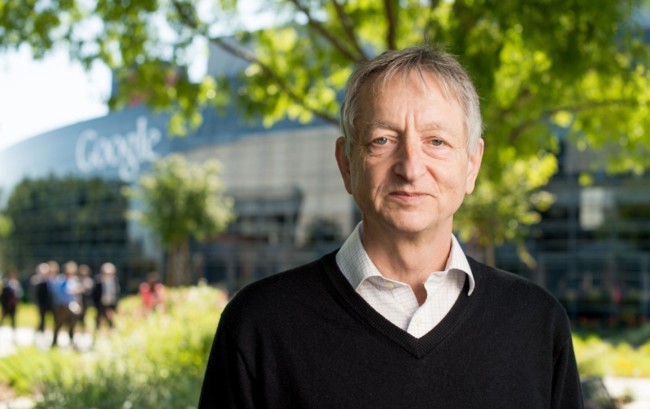
The researcher had an interview with The Guardian last year in which he spoke of the ” vectors of thought ,” a new concept being developed and with that you think may represent complex and abstract thoughts. That’s according to Hinton and his team help equip the machines s capacity logic and natural conversation that until now had been represented in the world of cinema.
Hinton was working on a system eminently devoted to studying the way we talk and express ourselves so that this artificial intelligence system could “deconstruct” these phrases with mathematical precision not to draw logical conclusions from the input data, but rather to provide these systems some intuition. To go beyond the automatic response. Even he is pointing to things like a oriented “flirting” with another person like making the protagonist voice said film program ‘Her’- not be too difficult to implement.
And while robots are also moving
Although Google is a company eminently recognized for his work on hardware developments, these developments are also closely linked to the hardware development will allow some devices can take advantage of these advances: the robots .
The company has been working in this area and its commitment became clear when two years agobought Boston Dynamics , the company known for its large four-legged robots that mimic the movement of certain animals and are specially trained to move in different types of terrain both indoors and outdoors.
That bet has resulted Replicant , an initiative formed by different companies that Google has acquired in recent times - Shaft and Redwood Robotics are two other good examples and has become an integral part of the strategy that Google has in this scope. Andy Rubin led this project before branching off of Google to create his own investment firm, but said goodbye with a prediction: [Before 2020] this team will take more than 20 years of research in robotics and launch a 1.0 product suite that will be the cornerstone of future products for the end user to interact with the physical world. Rubin progress appears to have been a blow to this ambitious initiative, and indeed that vision uniform this policy seemed to have given the project seems to have lost substantially. But Google does not want to stop progress, and recently it was announced that both Project Titan unit -the satellites-drones and robotic unit will be part of the mysterious Google X laboratory of which are likely to see out projects that combine these developments thus could offer TensorFlow.